
The talent shortage as a starting point
Over a quarter of a century, the share of people employed in agriculture worldwide has fallen from 40% to 26%. Russia is no exception. It is precisely the talent shortage, alongside the demand for precision and lower costs, that creates steady demand for autonomous solutions — and the state acknowledges this openly.
The industry's answer is autonomy. The global market for autonomous agricultural machinery is growing by 18% a year, the market for agricultural drones by 26%. Rosagroleasing has already supplied more than 1,000 units of autopilot-equipped machinery and 13 agricultural drones.
Drones: where they are irreplaceable and what stands in the way
Unmanned aircraft systems handle tasks that ground machinery does worse or cannot do at all: treatment within a narrow weather window, work with tall-stemmed crops without damaging the plants, water savings of five to ten times with ultra-low-volume spraying, and mobility for localised treatment.
In 2025 agricultural drones treated 600,000 hectares. The plan for 2026 is more than a million.
At the same time, the Ministry was candid about the barriers: restrictions on the substances allowed for ultra-low-volume spraying, drift risks and regulatory limits, dependence on the navigation signal, and the high cost of insurance. It is to remove these that work will begin in 2026 on a strategy for the use of UAVs in agriculture — an industry document intended to take the market from isolated deployments to systemic scale.
The figures that convince
Autonomous and autopilot-equipped machinery is already in the fields and delivers measurable results:
• 24,000 units of autopilot-equipped machinery are in use in the agricultural sector
• around 12.5 million hectares are planned to be worked with such machinery in 2026
• up to 30% — the increase in productivity
• 20% — the reduction in spending on crop protection products
• 18–25% per hectare — the reduction in total costs when autopilots and intelligent systems are used
Soil, AI and remote sensing
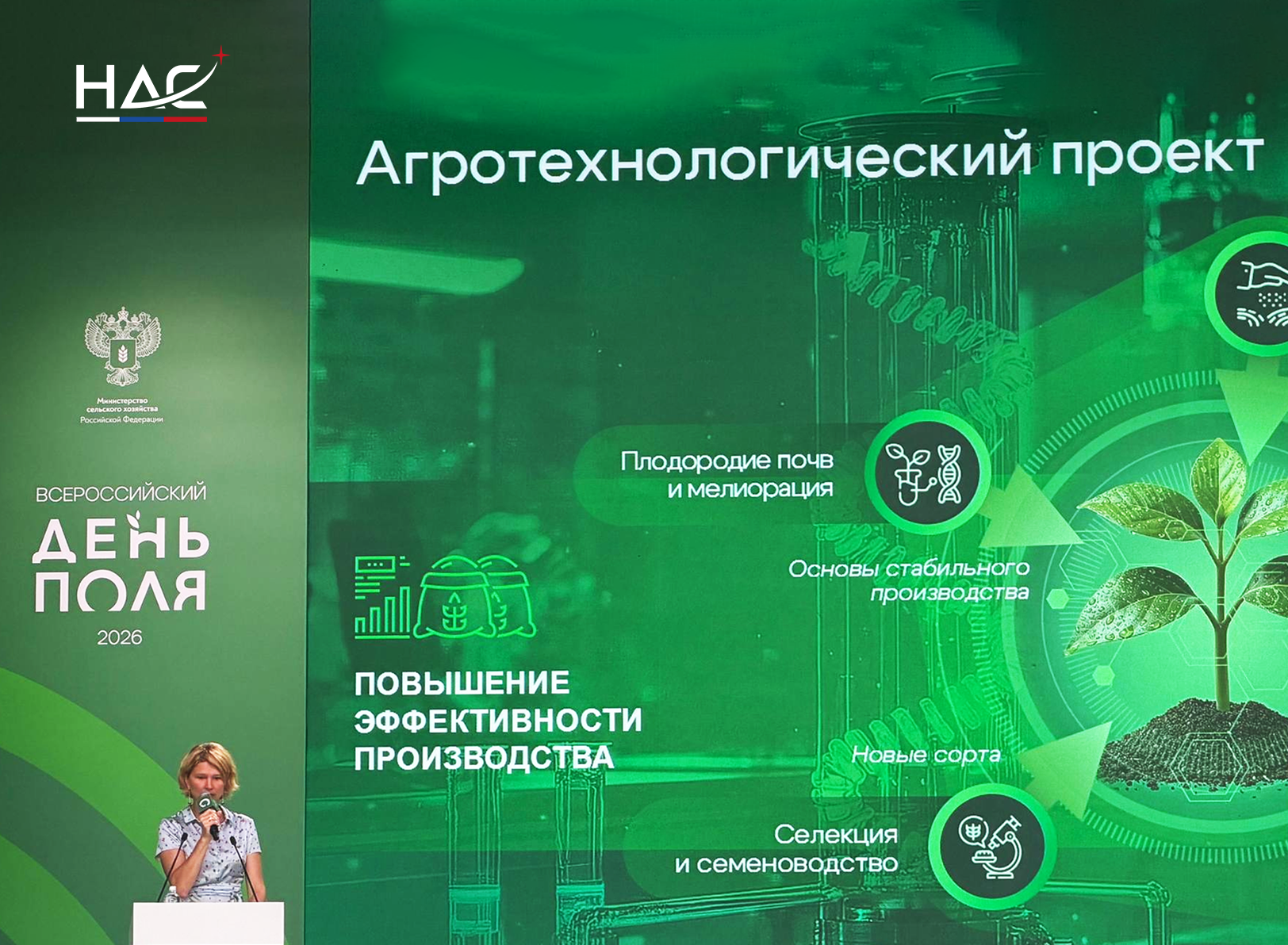
A separate part of the session was devoted to soil fertility — the foundation of the whole agricultural system. Of 132.5 million hectares of arable land, more than 27 million show no signs of active use. A restoration programme is starting in seven pilot regions. The monitoring tools are Earth remote sensing, artificial intelligence and unmanned aircraft systems.
It is precisely the integration of airborne, ground and digital systems into a single ecosystem that creates the precision effect the Ministry spoke about — and that coincides directly with the profile of the NAS Association's work.
"Field Day showed that the conversation about autonomous technologies in agriculture has finally moved from 'when will this happen' to 'how do we scale what already works'. Developing a strategy for the use of autonomous systems in agriculture is exactly the step that will give the industry systemic rules of the game. The NAS Association is ready to take part in this work — we have both the expertise and a direct dialogue with regulators."
Anna Manakhova, Director of the National Autonomous Systems Association
Agriculture is among the key areas of application for autonomous systems in the NAS Association's strategy through 2035.