The key challenge: a shortage of specialists threatens technological sovereignty
By the Association’s estimates, by 2030 the Russian economy will need more than 3 million specialists to work with autonomous systems — from drone operators to AI and cybersecurity engineers.
Yet over the three years of the national “UAS” project, only 12 certified instructors for heavy UAVs (over 30 kg) have been trained in the country.
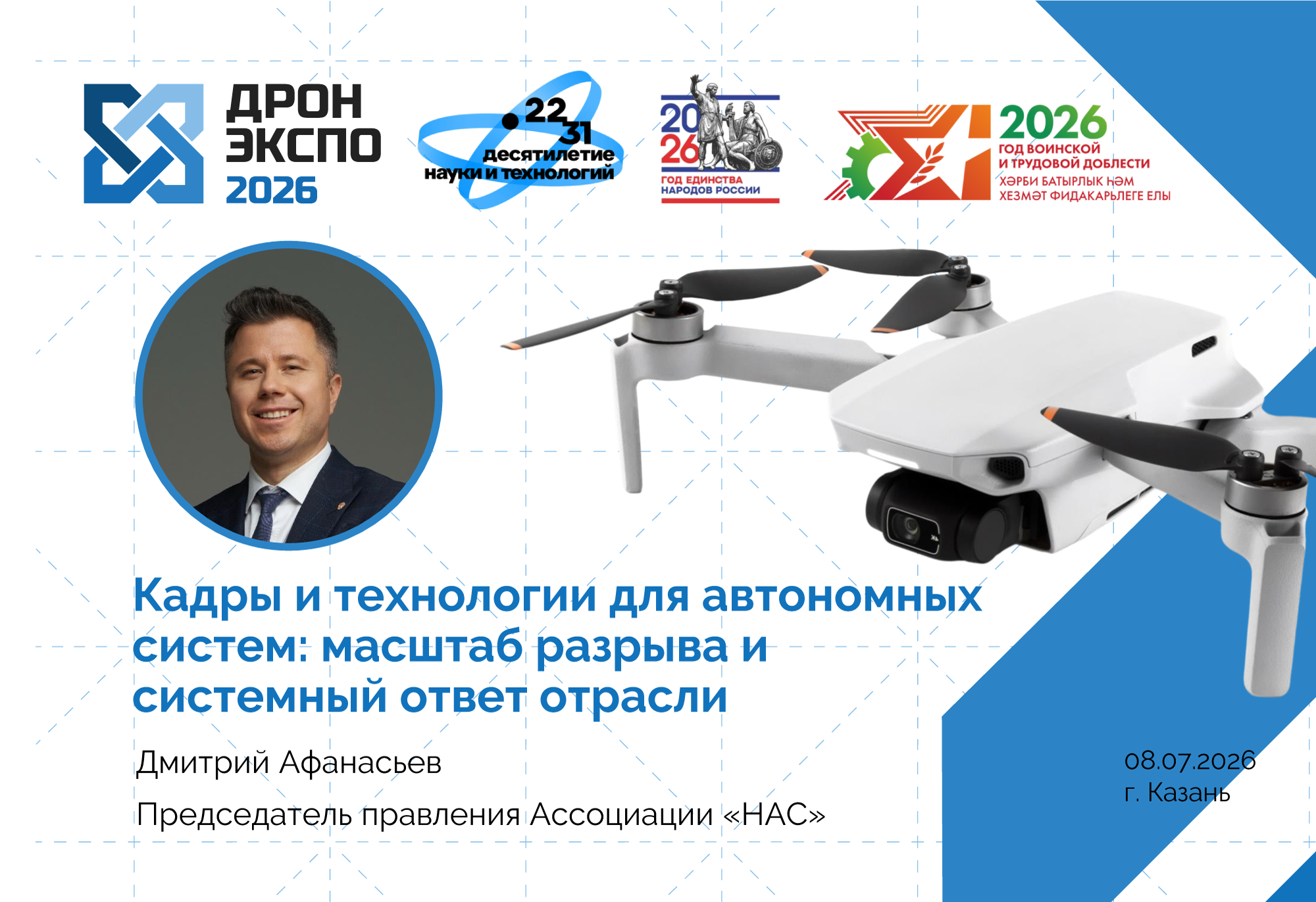
“Technology is developing faster than the system for training people to use it at scale,” said Dmitry Afanasyev. “The main task today is not just to train operators, but to build a new professional architecture for the industry.”
Three critical gaps
The NAS Association identifies three types of gaps holding back the industry:
1. Regulatory
The regulatory framework inherits the logic of manned aviation, even though an autonomous-system operator manages the mission and the data rather than “piloting” in the classic sense.
2. Engineering
Without its own engineers, developers and service specialists, localisation, cybersecurity and technological sovereignty are impossible.
3. Social
Autonomous systems do not replace people — they change their role: from manual labour to management, analytics and decision-making.
The NAS five-step programme
1. A unified competency map
Define the professions of the autonomous economy: operator, engineer, instructor, data specialist, service engineer, safety specialist, solutions integrator.
2. Industry training standards
Align the programmes of colleges, universities, continuing education and corporate training with the real needs of the industry.
3. Regional competency centres
Create pilot links of “region — university — manufacturer — operator — regulator”.
4. A fast track to practice
Provide access to real test ranges, mentors and practical scenarios with measurable results.
5. Industry monitoring of the personnel shortage
Continuously track shortages of operators, engineers, instructors and teachers.
Why we must act now
The window of competitiveness is limited. The countries that are first to train specialists for autonomous systems will capture the markets, the standards and the value chains.
A national priority. Following the President’s instruction to prepare an autonomous systems strategy, the personnel track must develop in parallel with the infrastructure and the regulatory framework.
People cannot be created instantly. Even in an optimistic scenario, the path from an education programme to a working specialist takes at least two years.
The Association’s position
“The National Autonomous Systems Association is ready to become the industry platform for assembling the personnel system of the autonomous economy,” Dmitry Afanasyev emphasised.