
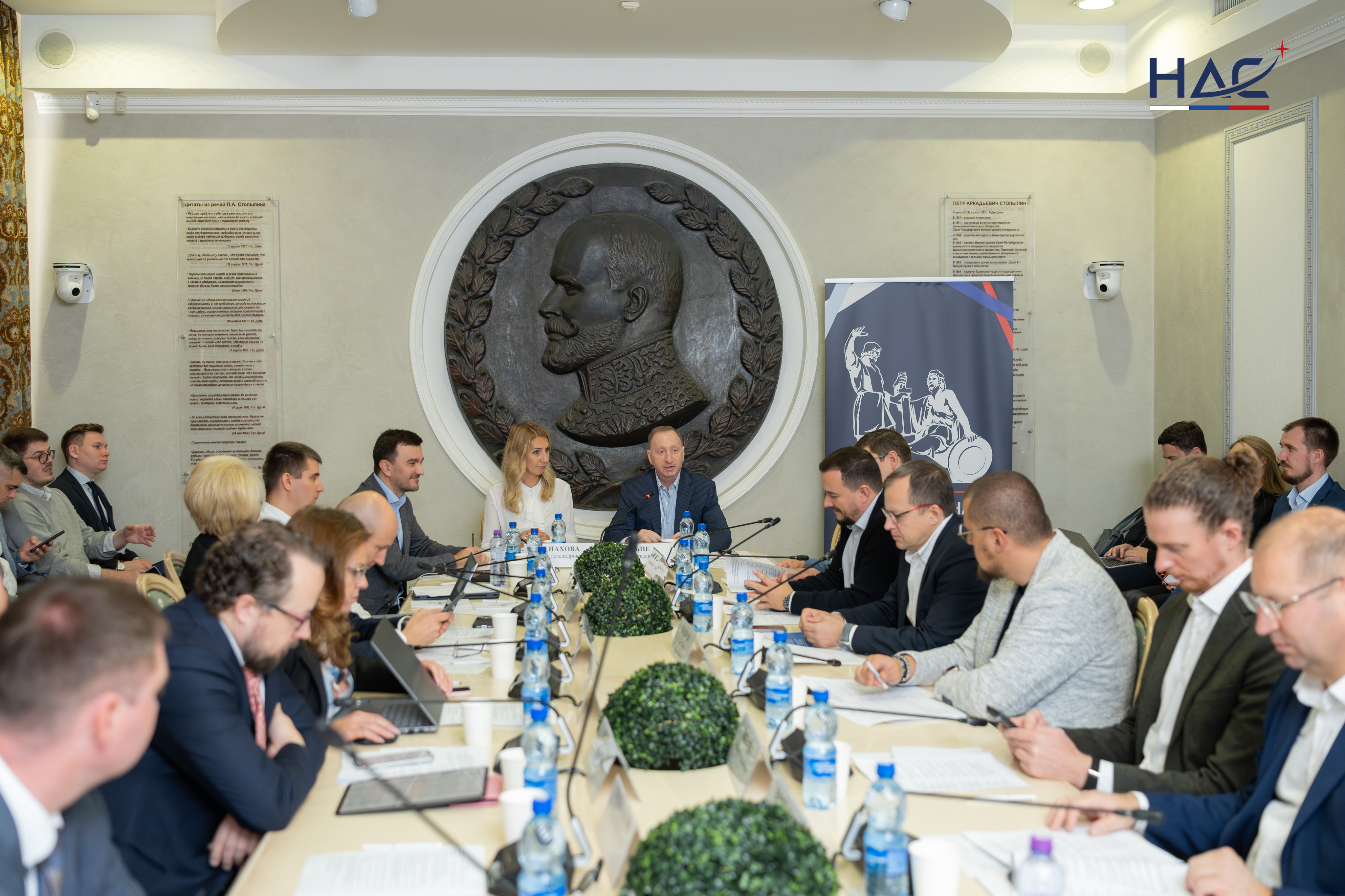
The event became a significant stage in the consolidation of the industry as part of the execution of the order of the President of the Russian Federation (Pr-1758). Currently, the formation of a national strategy for the development of autonomous systems in Russia until 2036 is underway, the NAS Association is an official co-executor.
The discussion brought together an unprecedented number of participants: more than 100 leading experts took part in the meeting in a hybrid format. Among them are representatives of the largest technology players (Yandex, SATEL Group, Kalashnikov Concern JSC, MT-Integration Group of Companies, T-Technologies, etc.), heads of research centers (MIPT, RUT (MIIT)) and the real sector of the economy.
Physical AI as a response to economic challenges
The round table was opened by the director of the NAS Association Anna Manakhova and the president of the MT-Integration Group of Companies Boris Volpe. In her conceptual report, Anna Manakhova outlined the development of autonomous systems not just as a technological trend, but as a strategic tool for overcoming the structural, demographic and logistical limitations of the Russian economy.
_“The vast territory of our country should not become our problem, but our potential,” stressed Anna Manakhova.
She noted that the priority for Russia should be the formation of a sovereign software stack and Physical AI models (physical AI capable of interacting with the real world). According to the expert, if hardware dependence can be temporarily leveled through global supply chains, then software localization is an absolute matter of national security. Without its own AI, any autonomous system remains only a vulnerable mechanism.
Data, certification and “exam for AI”
Continuing the discussion about the foundation of Physical AI, participants raised the problem of a shortage of arrays for training models. General Director of Big Data Platform LLC Andrey Totmakov emphasized that data today is the same basic industry resource as computing power and the component base, and the price of an autonomous system error requires 100% traceability of datasets.
_“The key barrier is data distribution. They are scattered across different owners, formats and access modes. The question is not only the availability of data, but also how to use it securely. In Strategy 2036, it is necessary to separately specify the conditions for the exchange of industry data, otherwise the development of domestic systems will be limited not by the capabilities of programmers, but by the lack of “fuel” for training,” noted Andrey Totmakov.
This idea was developed by the director of the Center for AI in Transport of RUT (MIIT) Fyodor Shkurov. He dedicated his speech to the “exam for artificial intelligence.” The expert explained that the admission of autonomous vehicles should begin with checking the datasets on which the neural network was trained. Shkurov proposed introducing a system of mandatory certification and "dataset passports", and organizing tests in three stages (testing ground, real movement, simulators), summing up: "What is not in the data, AI will not be able to learn".
Digital infrastructure and “man in the loop”
Shifting the focus from algorithms to infrastructure, Deputy General Director of SATEL Group Alexander Taskaev explained that the operation of autonomous systems is impossible without the digitization of physical objects. Today, information about infrastructure is scattered, some of it is stored on paper.
The solution should be the creation of digital information models (DIM) - machine-readable infrastructure twins with stable IDs. Alexander Taskaev proposed entrusting the routine assembly of such models to AI agents, and to reduce the technological gap using open models additionally trained on domestic industry data.
General Director of Bryansk Gormolzavod OJSC Dmitry Tsurkan spoke about how this approach works in continuous food production. Noting the growing shortage of personnel, he called autonomy inevitable, but warned against excessive trust in machines in critical areas.
_“Autonomy must be graduated. In food production, the industrial safety layer (hard limits) is never delegated to neural networks—it remains completely independent. We need Explainable AI - explainable AI without black boxes. At the first stage, AI should work as an “operator advisor,” preserving the principle of human-in-the-loop (human in the control loop), because legal responsibility for the product always lies with the person,” emphasized Dmitry Tsurkan.
The topic of industrial application was supplemented by the commercial director of Industrial Robotics LLC Igor Nikolaenko, who showed how machine vision today allows logistics robots to independently build routes in warehouses even in the complete absence of markings.
And the commercial director of the MIPT Institute of AI Anna Smirnova stated that Russian technologies of the 4th level of autonomy are ready for real use. Given the snow and poor markings, MIPT is relying on lidar localization, having already achieved an error of less than 10 cm without using GPS in the Gazelle e-NN unmanned cargo project.
GR-agenda and outlines of Strategy 2036
Summarizing the industry's needs for state support mechanisms, Nadezhda Surova, director of the Digital Economy Competence Center and member of the Council on Digital Economy of the Federation Council, presented a comprehensive package of initiatives.
Among the key proposals in Strategy 2036:
- Highlight the selection of projects by share of added value of AI in the final product.
- Subsidize the costs of testing and certification of AI components as direct implementation costs.
- Create a pipeline of anonymized industry data, providing access to it in exchange for participation in support measures.
- In government procurement, switch to purchasing according to the “autonomy as a service” model (result, not “hardware”).
- To assign to the Association “NAS” the role of a single window for the consolidation of industry applications in all five environments (Air, Earth, Water, Space, Digital).
The systematic outcome of the discussion was summed up by the General Director of the Alliance in AI Association Valeria Vorobyeva. Metaphorically describing the Physical AI market as a “six-story building” (from computing and simulation to fleet management), she noted Russia’s unique competitive advantages:
_“Our vast distances and difficult climate are an ideal environment for testing autonomous systems. Our economy has shown amazing stability; we are able to create the most complex solutions under sanction pressure. This experience makes Russian technologies extremely attractive to friendly countries,” Vorobyova concluded, calling on the state to maintain a balance between the accumulation of data, the development of science and flexible ethical regulation without unnecessary barriers.
What's next? Currently, the organizing committee of the “NAS” Association is consolidating all the initiatives voiced during the discussion. Based on the results of the round table, a resolution will be formed, which can become a conceptual basis for the formation of specialized sections of the national strategy for the development of the autonomous systems industry.