
From pilots to industry: what changed in a year
2025 became a turning point for Russian unmanned aviation. UAS production grew by 68% against the plan, reaching 22,165 units versus a forecast of 13,189. These are not just reporting figures — they are a signal that real production capacity has been created, technological processes have been fine-tuned, and demand from business and the state is growing steadily.
The share of Russian drones on the domestic market rose to 68.86% — almost 26 percentage points above the plan. Just two years ago such figures seemed ambitious. Today it is a reality, backed by concrete projects deploying UAS in agriculture, logistics, energy, construction and other sectors.
________________________________________
Infrastructure for growth: from regions to technologies. The industry’s development is impossible without a systemic approach. Over the year, infrastructure has been created that makes it possible not only to produce drones but also to use them effectively:
🔹 29 national pilot centres (NPCs) in Russia’s regions — sites for testing, refining technologies and commercialising projects. More than 500 companies — from startups to large industrial holdings — have become NPC residents.
🔹 12,200 specialists trained — engineers, operators, operating personnel. The industry is gaining the workforce able to work with a new generation of technologies.
🔹 Class-H airspace created — special zones for UAS flights with a simplified approval procedure, which is critical for commercial use.
🔹 A remote identification system launched, based on GLONASS and the Nebosvod complex — it ensures flight safety and the integration of drones into common airspace.
🔹 8 UAS models certified for civilian use — from compact aerial-photography systems to heavy industrial platforms. This allows companies to use drones legally in business processes and obtain insurance and licences, and to take part in public procurement.
________________________________________
Technological independence: from 42% to 81%
The industry’s current level of technological independence is 42.5%. This means that almost half of the critical components and technologies for UAS production are already localised in Russia. But the path to full sovereignty is only beginning. By 2030 the goal is to reach 81.1% technological independence. This will require breakthroughs in the most difficult areas:
✔️ Engines — compact, efficient, reliable
✔️ Control systems — flight automation, artificial intelligence
✔️ Navigation and communications — jamming resistance, range, data-transfer speed
✔️ Payload — cameras, sensors, specialised equipment
The NAS Association notes: achieving these targets is possible only through close cooperation between the state, scientific institutions and business. It is precisely for this that the platform of national pilot centres was created — places where developers can gain access to test ranges, expertise and funding.
________________________________________
What comes next: plans for 2026–2027
The Ministry of Industry and Trade has outlined the industry’s priorities for the next two years. This is not just technical modernisation — it is the creation of a market where unmanned technologies become a familiar tool for business.
A regional dronification ranking
For the first time a ranking of the effectiveness of UAS use across Russian regions will be compiled. This will show which regions are actively adopting drones into their economy and which are lagging and need support. Competition between regions is a powerful driver of growth.
Cashback for business
A mechanism for reimbursing the costs of purchasing and operating UAS is being launched — an analogue of industrial “cashback”. Companies that adopt drones will be able to compensate part of their expenses. This will lower the barriers to entry for small and medium-sized businesses.
UAS in oversight and inspection
State inspectorates will start using drones on a mass scale to inspect industrial facilities, monitor compliance with environmental standards and control construction. This will not only increase the effectiveness of oversight but also create steady demand for UAS from the public sector.
Expanding NPCs to multiple domains
National pilot centres will move beyond unmanned aviation — ground and water robotic systems will enter their orbit. This is logical: the technologies are similar and the synergy is obvious.
Next-generation landing and communications systems
R&D is beginning on precision landing systems and secure communications (C2 links) for UAS. This is critical for autonomous flights in difficult conditions — in the mountains, at sea, amid radio interference. ________________________________________
Four areas of mass adoption
By 2030, unmanned systems should become an integral part of four key sectors of the economy:
🔹 Aviation. Integrating UAS into common airspace. Creating routes for cargo drones — delivering medicines, mail and spare parts to hard-to-reach areas. The prospect of passenger drones.
🔹 Agriculture. Precision farming, monitoring crop conditions, applying fertilisers and crop-protection agents. Drones save resources and raise yields by 15–20%.
🔹 Logistics. “Last-mile” delivery — from the warehouse to the consumer. Express transport between cities. Reducing the load on road infrastructure.
🔹 Aerial surveying and search-and-rescue. Creating up-to-date maps, monitoring emergencies, searching for victims in the mountains, forests and on the water. Response speed increases many times over. ________________________________________
💬 The position of the NAS Association: we’ve learned to produce — now to develop civilian use
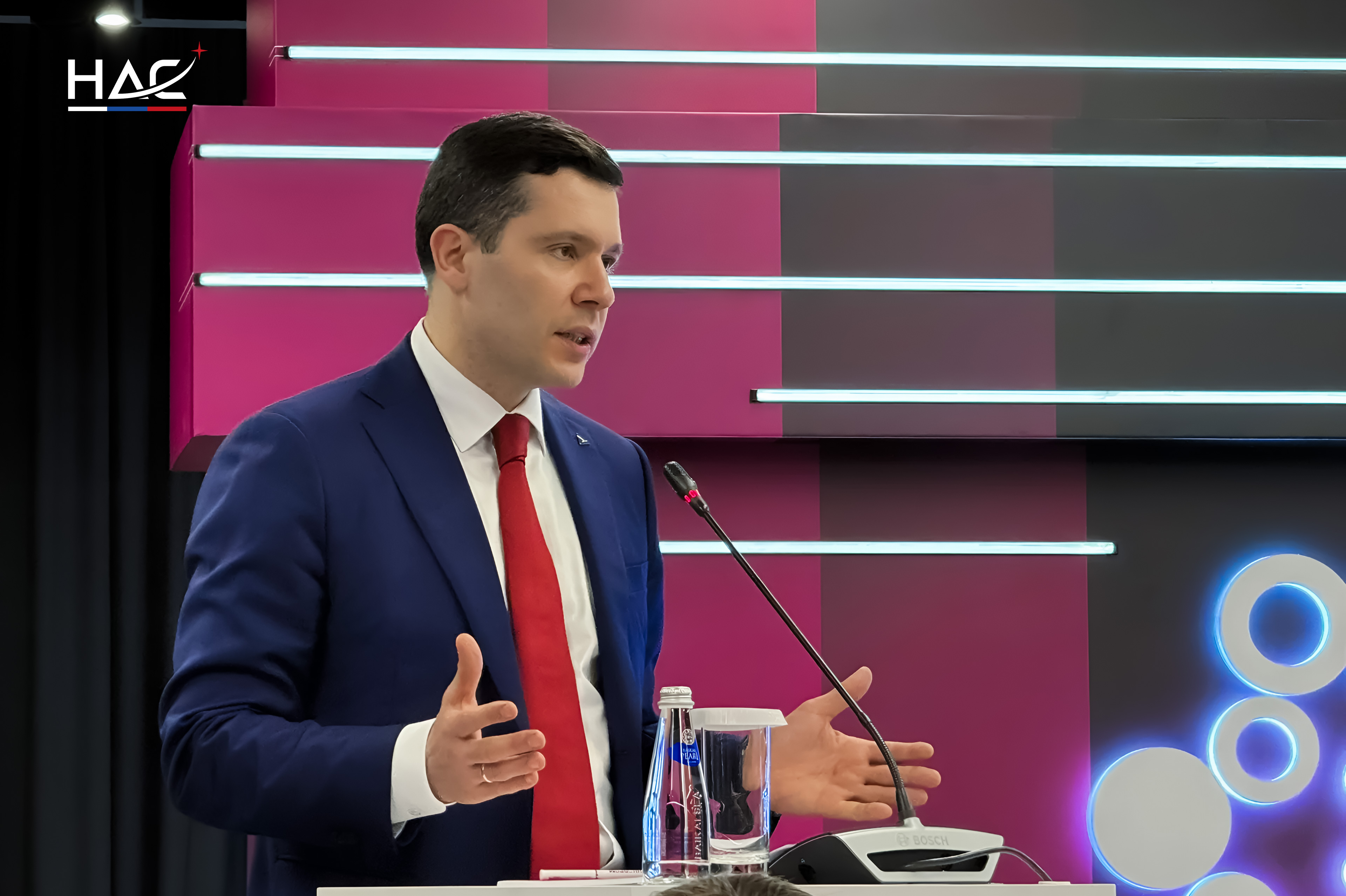
“The results of 2025 show that the stage of creating the industry ‘from scratch’ is complete. We have learned to produce — capacity has been created, technological processes fine-tuned, output is growing. This is an important milestone.
But the industry faces an equally important task — to develop the civilian use and mass operation of UAS. It is not enough to produce 22,000 drones. They must work effectively in the real economy — in the fields, in logistics, in inspections, in emergency and rescue services.
This requires solving a set of tasks:
🔹 Creating a service infrastructure. Regional UAS servicing and repair centres, the availability of spare parts, and prompt technical support are needed. A drone is not a one-off purchase; it is equipment requiring support throughout its life cycle.
🔹 Training industry specialists. 12,200 trained is only the beginning. Tens of thousands of operators are needed who not only know how to fly a drone but understand how to integrate it into the production processes of specific industries.
🔹 Refining business models for operators. Companies must see a clear economic benefit from adopting UAS. The “cashback” mechanism is a good tool, but it is important to create standard turnkey solutions for different sectors of the economy.
🔹 Developing the regulatory framework. Class-H airspace and the identification system are important steps. But further simplification of procedures for commercial operation is needed, especially in cities and near critical infrastructure.
🔹 Building a culture of use. Unmanned technologies must become a familiar tool rather than an exotic novelty. This takes time, successful cases and publicity for the results. National pilot centres are the key platform for this transition. They must become not only test ranges but also sites where business can ‘get a feel for’ the technology, obtain advice and run a pilot project before scaling.
The path to 81% technological independence will require not only investment in R&D but also a change of approach to cooperation. Today many companies work in isolation. NPCs must become the assembly points of the ecosystem — where developers of engines, control systems and payloads come together to create a competitive product.
The regional dronification ranking will help identify the best practices of UAS use and replicate them. But the main thing is that these practices work for the real economy, not for statistics.
‘We’ve learned to produce. Now the task is to teach the economy to operate these technologies effectively,’” noted Anna Manakhova, Director of the National Autonomous Systems Association. ________________________________________