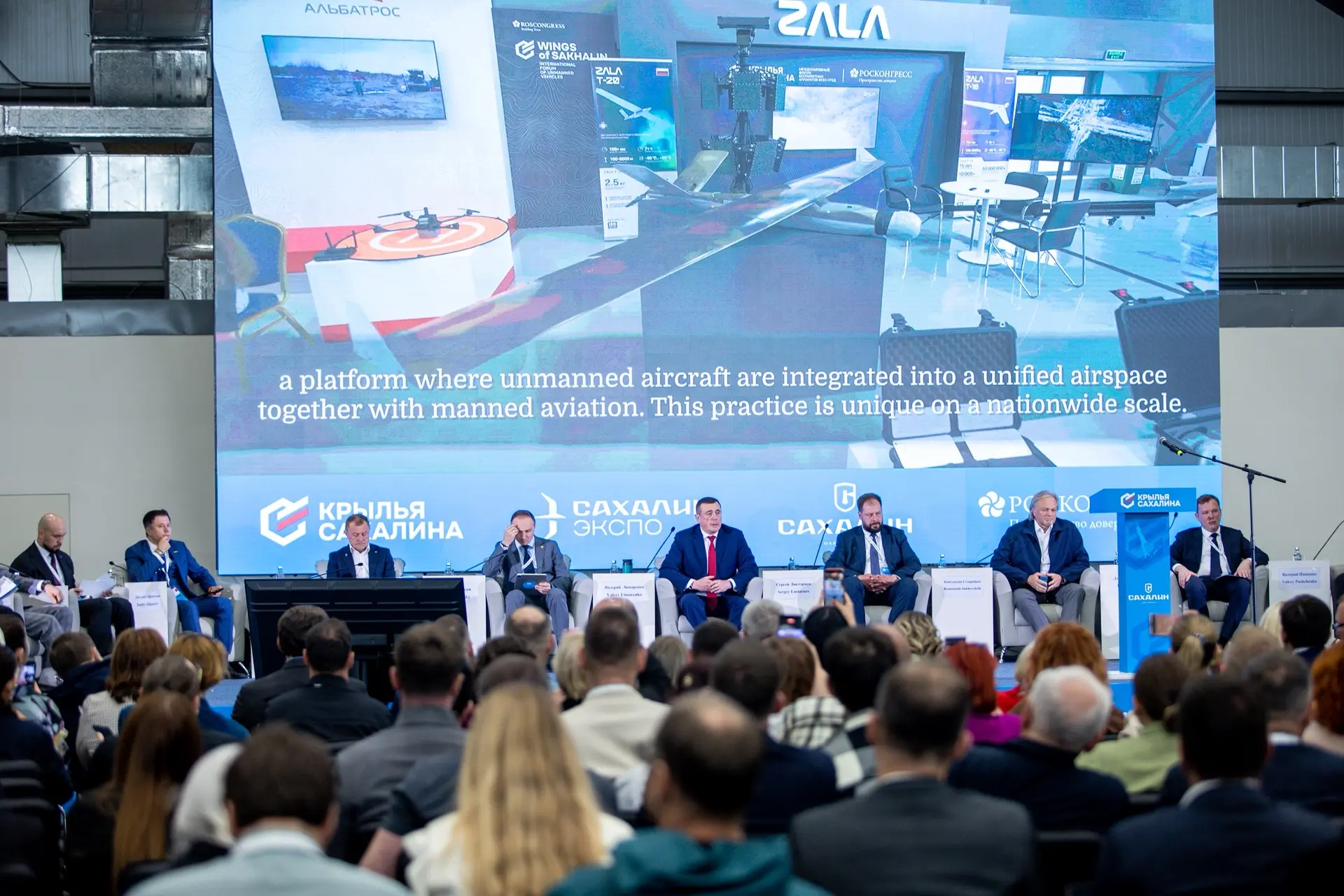
The NAS Association was represented at the session by its Chairman of the Board, Dmitry Afanasyev, who put forward a key thesis: the Sakhalin Region is an ideal “island laboratory” for working out the synergy of three elements — air, water and land.
“Sakhalin is not just a point on the map. It is a region where nature itself has created conditions in which autonomous systems cease to be a fashionable trend and become a matter of economic resilience. Cyclones, the lack of roads, the personnel shortage and dependence on the mainland demand solutions that reduce risks for people and increase the efficiency of logistics, monitoring and production,” noted Dmitry Afanasyev. He proposed a practical architecture for the interaction of autonomous systems across all domains, including: • delivering vital cargo to remote settlements using UAS and unmanned vessels, • using ground robots at coal pits and warehouses, • monitoring bioresources and infrastructure using AI analytics, • inspecting sea supports and pipelines with uncrewed underwater vehicles.
However, to launch such integrated chains it is necessary to overcome the regulatory “gateways” separating airspace, sea and land. Afanasyev called for: • extending the experimental legal regime (ELR) mechanism to all types of autonomous systems, • developing unified rules for identification and traffic management in a single digital space, • creating a regional “autonomy passport” — a tool for assessing the needs and possibilities of adopting technologies.
His address was part of a broad dialogue in which: • the Ministry of Industry and Trade presented, for the first time, the National Dronification Ranking of Russian regions, • GLONASS demonstrated the Drone ID platform without dependence on cellular communication, • ZALA announced the deployment of the sovereign GEOKOSMOS network for operating under electronic-warfare and Arctic conditions, • Aurora spoke about the first inter-island UAS flight from Kunashir to Sakhalin, • experts discussed involving veterans of the special military operation in the civilian industry and rethinking personnel policy. Closing the session, moderator Alexey Chadaev stressed: “Unmanned vehicles of all domains are not a set of separate technologies but a single ecosystem. And only the joint action of the state, business and science will allow us to build it as a ‘single swarm’.”
The NAS Association confirms its readiness to help implement the Sakhalin model across the whole of Russia. Already now the Association is offering the regions a methodology for developing autonomy passports and assistance in creating pilot zones where technologies will work not in isolation but in synergy — for the sake of the country’s safety, efficiency and technological sovereignty.